Pre-formatters
Added in version 2.1.
A pre-formatter rewrites the message of a record before
Simple formats it, for example to colour parts of
a message. It is a function that takes the message text and returns the new
text.
gouge ships one pre-formatter,
uvicorn_access(), for the access log of the
uvicorn web server. Without it, the message of an access log line has one
colour:
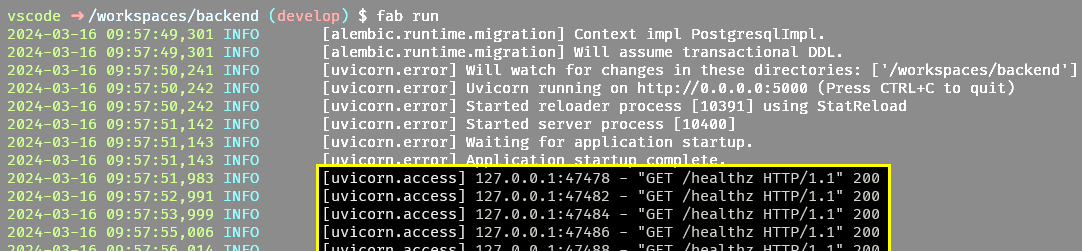
uvicorn access log without a pre-formatter.
With it, the client address, method, path, HTTP version and status code each get their own colour:
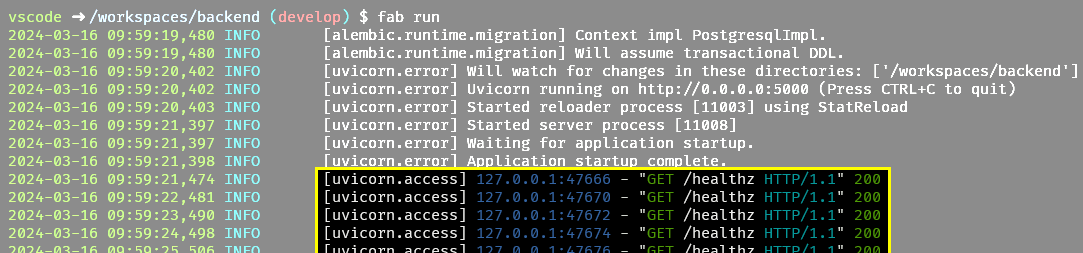
uvicorn access log with
uvicorn_access().
Write a pre-formatter
Map logger names to lists of pre-formatters with the pre_formatters
option. They apply only to records of exactly that logger, not to its
children, and run in the order given:
>>> import logging
>>> from gouge.colourcli import Simple
>>> def shout(message):
...     return message.upper()
>>> def mark(message):
...     return f"** {message} **"
>>> handlers = Simple.basicConfig(
...     pre_formatters={
...         "app.alerts": [shout, mark],
...     },
... )
>>> logging.getLogger("app.alerts").warning(
...     "Disk full"
... )
2026-10-27 13:34:48,899 WARNING    [app.alerts] ** DISK FULL **
>>> logging.getLogger("app").warning(
...     "Disk full"
... )
2026-10-27 13:34:48,899 WARNING    [app] Disk full
Pre-formatters receive the message with its arguments already merged in,
and must return a str. msg and args of the record are not
changed, so other formatters still see the original message.
Refer to a pre-formatter by name
Added in version 2.3.
Instead of a function, give its dotted path. gouge imports it once, when
the formatter is created. Both "package.module.function" and
"package.module:function" work:
>>> formatter = Simple(
...     pre_formatters={
...         "uvicorn.access": [
...             "gouge.preformatters.uvicorn_access",
...         ],
...     },
... )
>>> formatter.pre_formatters
{'uvicorn.access': [<function uvicorn_access at ...>]}
A path that cannot be imported raises a ValueError naming it:
>>> Simple(
...     pre_formatters={"app": ["myapp.missing"]}
... )
Traceback (most recent call last):
  ...
ValueError: Cannot import pre-formatter 'myapp.missing': No module named 'myapp'
Dotted paths make pre-formatters usable in configuration files. See Configuration files.
Colour and pre-formatters
The colour codes a pre-formatter adds are removed together with the
others when colour is off, for example when NO_COLOR is set. A
pre-formatter can add colour codes unconditionally. See Controlling colour.